
Role? Agile Coach! – Questions? Lots of them!
Terms such as agility, servant leadership, and transformational leadership are gaining traction in both German and international organizations. It’s not uncommon for companies to actively seek out Agile Coaches to manage the growing need for change and the resulting organizational transformation. What defines this role? What qualities does such a person bring to the table? How does this role differ from others, such as that of a Scrum Master? We’ll explore these questions and provide you with a comprehensive understanding of the role of the Agile Coach.
To reduce complexity and make the text easier to read, we have omitted the feminine form. Please note that the term “Agile Coach” includes all genders.
What exactly is an Agile Coach?
If you look up this term and read about the skills and responsibilities associated with the role, you’ll quickly realize that the role and definition of an Agile Coach aren’t as straightforward as they seem. The term is used differently in various contexts, and its meaning can vary from organization to organization.
So what is the common ground, the essence of the role? An Agile Coach can be described as a person who supports individuals and organizations in becoming adaptable and self-learning. Only if an organization is adaptable will it survive in the long term. Being self-learning means that the organization independently evolves itself and its processes wherever it has identified a need for optimization.
An Agile Coach needs a wide range of skills to serve the organization effectively. These include, for example, understanding and applying leadership styles, expertise in Agile approaches and how to combine them, know-how regarding change management, and much more. However, the Agile Coach should by no means act as a lone warrior; rather, they should pave the way for employees and the organization by providing them with helpful tools and best practices. The Agile Coach opens the door—it’s up to the employees themselves to walk through it.
Why Do Organizations Need an Agile Coach?
In our modern, fast-paced world full of instability, uncertainty, complexity, and ambiguity (VUCA), companies are finding it increasingly difficult to keep up with the times and respond to change. Charles Darwin already made clear just how important a willingness to change is: “It is not the strongest of the species that survives, nor the most intelligent; it is the one most adaptable to change.” If we cross out the word “species” and replace it with “organizations,” we get the scenario in which we find ourselves.
What good are perfect structures and processes if they merely represent a fleeting moment and will therefore be outdated by tomorrow? What good are the most detailed plans if we can’t stick to them anyway due to changing market or environmental conditions? To shape change, we need this one role: the Agile Coach. Change doesn’t happen on its own; it requires support from someone with expertise whom employees and the organization can rely on. And that’s where you, as an Agile Coach, come in.
What does an Agile Coach do?
The impact of an Agile Coach can be well described using the Agile Onion model. Visibly, the Agile Coach changes an organization’s processes and tools while simultaneously empowering it to evolve and transform itself as needed. Introducing new tools, processes, and techniques is easy. This can be done at the “command and control” level. While these tools and processes are certainly helpful and can support agility, they are only the tip of the iceberg.
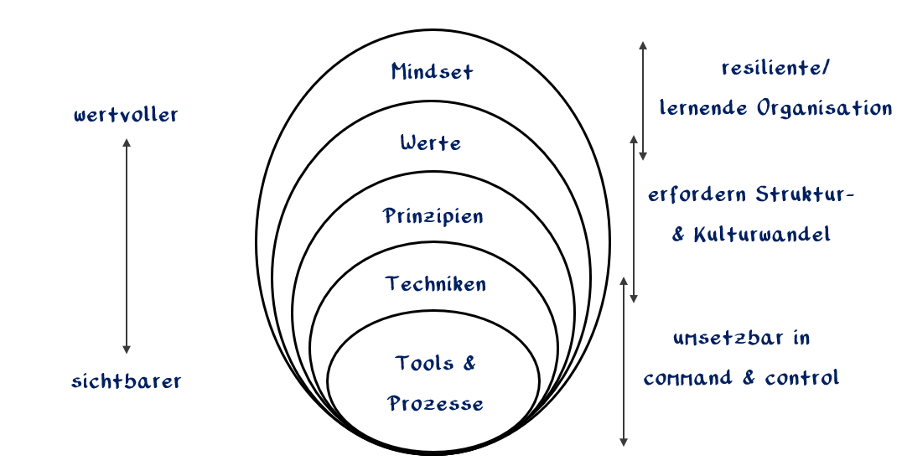
What is far more valuable—and often overlooked—is what is not visible to people: the shift in an organization’s mindset, attitude, and lived values (in other words, what lies “inside” the Agile Onion). An organization’s values must be established for the long term and are part of an Agile Coach’s day-to-day work. As a result, individuals’ beliefs, skills, and knowledge will change. This forms the crucial foundation for the success of change and agile transformation.
What are the duties, skills, and responsibilities of an Agile Coach?
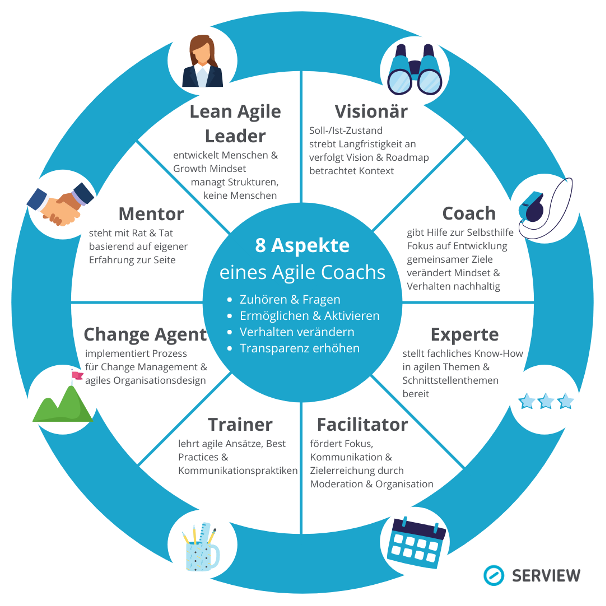
A role consists of the tasks, competencies, and responsibilities that the role must perform or possess. When it comes to the role of an Agile Coach, one thing is immediately apparent: it is an immensely complex role that requires both hard skills and soft skills. To give you an overview, we’ll examine the “AKVs” of an Agile Coach based on eight aspects that, in our view, define the role.
The Lean Agile Leader
As a Lean Agile Leader, the Agile Coach embodies all the requirements that agile approaches place on their leaders. The focus is on developing people, fostering a growth mindset, and—above all—managing structures, but never people. The Agile Coach empowers employees and the organization to manage and organize themselves.
As the driving force behind agile transformation—that is, the adoption of agile approaches and ways of working—the agile coach should possess expertise in various leadership styles, both in theory and, above all, in practice. The coach leads by example in matters of agility and shares their knowledge of leadership with the organization.
The Visionary
First, the visionary assesses the current state, which in practice is often done through agile assessments. He or she captures a snapshot of the current situation, places it within its broader context, and then works with the organization’s employees to develop a vision of the future. The agile coach keeps this vision in mind at all times and reviews the steps being taken to achieve it.
Agile approaches are all about customer focus. The same goes for the Agile Coach: He always places his clients at the center of his activities and vision, and does what is right for them. To do this, he should know his clients and stakeholders well. He also needs an intuition for their needs and the best way to meet them, so that he can guide his clients toward maximum success.
The Coach
As a coach, the Agile Coach helps teams reflect. He observes teams and the organization and reflects together with them. Through this practice, he raises awareness of their own blind spots and areas of potential. In this way, he develops valuable improvement measures.
Everyone needs coaching—from employees to top management to the entire organization. Change means letting go. And that’s never easy. That’s why employees need someone to turn to in order to find a way to cope with this change. The coach guides clients toward a solution through questions and trusts that the solution already lies within them. A core competency here is “listening and understanding.” In addition, the Agile Coach should master techniques and intervention methods to act in a way that is as beneficial as possible for the organization.
The goal of this aspect is to bring about lasting change in employees' mindsets and behavior and to pave the way for agile approaches.
The Expert
An Agile Coach should be thoroughly versed in Agile approaches and related practices. When is which framework most appropriate? What methods can we use to support them? Scrum, Kanban, OKR, and SAFe®should not be mere buzzwords, but rather a lived reality for the Agile Coach.
The expert should have answers to questions that arise in an agile environment: How is agile governance structured? How do we handle reporting? What metrics can we use? The agile coach analyzes root causes, evaluates solutions, and presents concrete solutions to clients.
The Facilitator
The Agile Coach has a talent for organization and facilitation. He applies this talent primarily during specific events, through which the Agile Coach supports, for example, decision-making, communication, and focus within the teams and the organization.
Interacting with people is part of an Agile coach’s daily routine. Different people require different communication styles to ensure everyone is on the same page and the goal is achieved. Therefore, the facilitator possesses excellent communication skills. He also ensures results-oriented communication within the team, which he supports through skillful facilitation.
The Coach
Teams that want to adopt agile methods typically have little or no prior knowledge of the next steps. In such cases, it is up to the agile coach to guide employees and the organization and teach new ways of working so that everyone is on the same page. The training can cover many areas, ranging from teamwork to agile approaches and communication to a culture of feedback.
The Change Agent
To enable change and get an organization’s employees on board, a structured approach and processes that can be integrated into the organization are needed. A new organizational design cannot be achieved overnight; rather, it involves a long process that is guided by the needs of the people within the company. At the same time, however, the process should contribute to the organization’s economic and strategic goals. The change agent serves as the link between these two aspects.
The Mentor
This is a task related to coaching. While in coaching the individual finds the solution to their own question, the Agile Coach acts as a mentor, supporting their mentee with advice and guidance. They serve as a kind of consultant and find solutions that would otherwise be unattainable. The mentor’s role also involves a strong partnership aspect, as they serve as the go-to person for obstacles and problems and maintain a trusting relationship with their mentee.
To do this, an Agile Coach needs empathy and good judgment regarding which tasks to perform at any given time—in a way that is appropriate for the situation and the environment. An Agile Coach thus possesses a wide range of different skills and competencies, all of which they use to ensure the most successful implementation of Agile approaches within an organization.
Agile Coach vs. Scrum Master—Which Is It?
The Scrum Master is certainly the model for the Agile Coach, and the two roles do indeed have a lot in common. For example, one step on the path to a career as an Agile Coach is to serve as a Scrum Master.
However, there is a significant difference right in the names of the roles: While the Scrum Master works within the Scrum context and for their Scrum team, the Agile Coach operates across the organization—not only within the Scrum context, but wherever agile practices are applied. Mastering the role of a Scrum Master does not automatically make you a good Agile Coach. However, an Agile Coach should definitely also be a good Scrum Master.
Agile Coach vs. Management Consultant—What's the Difference?
Many management consultants solve a client’s problem by presenting them with technical concepts—in other words, by actively proposing a solution to a challenge. Depending on the context, this can be helpful.
An (agile) coach, on the other hand, develops the solution concept together with the client and helps the client help themselves, so that by the end of the collaboration (if the coach is an external agile coach), the client knows how to drive change on their own. As a self-learning organization, the client knows exactly how to act in various situations after the collaboration.
Unlike consulting, in coaching, the responsibility for developing and implementing action plans lies with the client. Coaching is generally more effective for fostering sustainable agile collaboration. Results and strategies developed collaboratively lead to greater commitment from the workforce and a higher success rate in achieving goals.
The Agile Coach at SERVIEW
Is the information provided so far not enough for you? Would you like to get straight to the point? In the Agile Coach training program, you’ll polish your skills to perfection! Here, through engaging scenarios, you’ll quickly learn how to fulfill this role in practice and what tools you’ll need to do so.
About the Agile Coach Training Program
How else can SERVIEW help you?
Are you facing a challenge in an agile environment and have tried many approaches but still haven’t found a solution? Our top-notch Agile Coaches will actively support you in finding a solution and are ready to listen and roll up their sleeves to help. Just reach out to us!