
The Comprehensive ITIL Version 5 (the new ITIL) FAQ with All the Answers


















The introduction of ITIL Version 5 raises many questions—from the new features of the latest version and transition guidelines to appropriate training and the right certification path. This FAQ provides guidance for anyone interested in ITIL Version 5 or planning to take a training course.
As PeopleCert’s first Platinum Partner in Germany and with over 20 years of ITIL experience in the DACH region, SERVIEW draws on its expertise gained through training, consulting, and close collaboration with the copyright holder. The answers are based on the official guidelines for ITIL Version 5 and will help you make informed decisions about your next step toward certification.
ITIL Version 5 is the latest evolution of the globally established ITIL framework. It builds on the proven concepts of earlier ITIL versions but consistently expands upon them to meet the requirements of modern digital organizations. The focus is no longer exclusively on IT services, but rather on the holistic management of digital products and services throughout their entire lifecycle. ITIL Version 5 serves as a practical framework for organizations that wish to systematically integrate value creation, collaboration, governance, experience, and continuous improvement—even in complex, AI-driven environments.
The digital landscape has undergone fundamental changes in recent years. Organizations are increasingly adopting a product-centric approach, must respond more quickly to change, and face new challenges posed by automation, artificial intelligence, and rising expectations from customers and employees. ITIL Version 5 was developed to address these realities. It helps organizations manage digital products and services in an integrated manner, make confident decisions, and enable sustainable value creation—without abandoning proven ITIL principles.
In the official naming convention for training courses, the new version is listed as “Version 5” in parentheses at the end, for example, ITIL Foundation (Version 5). In PeopleCert’s communications (advertisements, posts), the term “The new ITIL” is often used initially, and the version number is added later in the text. In everyday language—particularly in social media posts by experts, consultants, and training providers—the terms “ITIL 5” or “ITIL Version 5” have already become more widely established. The term “The new ITIL” is particularly suitable for the introductory phase but loses its distinctiveness as the new version becomes more widespread.
Within the next twelve months at the latest, the version number 5 is expected to become the key distinguishing feature from earlier ITIL versions—not as a way of devaluing older versions, but as a clear point of reference in the market. It remains to be seen whether the notation “ITIL 5,” “ITIL Version 5,” or the form preferred by PeopleCert (“Version 5”) will prevail. Ultimately, what matters is not the exact spelling, but that customers can always clearly identify which ITIL version they are dealing with.
ITIL Version 5 introduces, for the first time, a unified Digital Product & Service Lifecycle that treats products and services not separately, but as a single entity. The focus on customer experience and employee experience has been significantly strengthened and is firmly embedded in the models. Another new feature is the AI-native approach: ITIL Version 5 is explicitly designed for complex, AI-enabled environments and provides guidance on handling automation, data-driven decisions, and accountability. At the same time, roles, responsibilities, and expected outcomes have been more clearly defined to facilitate practical application.
No. ITIL Version 5 goes well beyond traditional IT service management. The approach is aimed at all areas involved in the development, delivery, and enhancement of digital products and services. In addition to IT organizations, this includes product management, digital business units, experience teams, governance functions, and management.
ITIL Version 5 views product and service management as interconnected disciplines and provides a common language for IT, business, and executives. As a result, ITIL Version 5 is particularly well-suited for organizations that want to break down silos and collaborate across departments.
No. ITIL Version 5 is an evolution, not a revolution. Proven concepts from ITIL 4 and earlier versions remain, including the Value System, the Guiding Principles, the concept of value streams, and the focus on continuous improvement. ITIL Version 5 builds on these concepts and reorganizes them to better align with modern ways of working, product-centric thinking, and digital organizational models.
ITIL Version 5 is intended for anyone who plans, develops, operates, or manages digital products and services. This includes newcomers as well as experienced specialists and managers, employees in IT, service management, product management, and digital business units, as well as decision-makers with strategic responsibilities. Consultants and external service providers also benefit from the common language and clear framework provided by ITIL Version 5.
Two bridge training courses are available for the transition to ITIL Version 5: the ITIL Version 5 Transition and the ITIL Version 5 Foundation Bridge. Both were developed to facilitate an efficient, recognized, and targeted transition from ITIL 4 to ITIL Version 5—tailored to each participant’s current level of qualification.
The ITIL Version 5 Transition training course is designed for participants who hold the ITIL v3 Expert or ITIL 4 Managing Professional certification. It was specifically developed to facilitate the transition to the ITIL Version 5 Managing Professional designation. The Transition course is designed as a five-day intensive training program and consolidates all key changes in ITIL Version 5 into a compact, practical format.
The ITIL Version 5 Foundation Bridge is designed for anyone who already holds the ITIL 4 Foundation certification and wishes to transition to ITIL Version 5 Foundation. This bridge training course is intentionally kept concise; it lasts one training day and concludes with a shortened exam. It specifically covers the relevant changes and new features of ITIL Version 5 without unnecessarily repeating familiar content.
Important:
The Transition is not relevant for holders of the ITIL 4 Practice Manager or ITIL 4 Strategic Leader designations. In these cases, you must successfully complete only the ITIL Transformation module to obtain the corresponding ITIL Version 5 designation.
If you already hold an ITIL 4 Foundation certification, you do not need to “update” or replace it. Your ITIL 4 Foundation certification remains fully recognized and continues to serve as a formal prerequisite for all advanced modules in the ITIL Version 5 certification scheme. Specifically, this means you can proceed directly to the advanced ITIL Version 5 certifications, such as the learning paths for ITIL Practice Manager, ITIL Managing Professional, or ITIL Strategic Leader. Retaking the Foundation exam is not required for this. At the same time, we recommend that many participants with an ITIL 4 background intentionally use the ITIL Version 5 Foundation training as a content update. ITIL Version 5 expands on ITIL 4 with significant new perspectives, including the unified Digital Product & Service Lifecycle, a much stronger focus on customer and employee experience, and the AI-native approach. The Foundation course helps participants organize these new concepts in a structured way and develop a shared understanding of the new mindset.
The transition to ITIL Version 5 is clearly defined and specifically takes existing ITIL certifications into account. A five-day ITIL Transition (Bridge) training course is offered to facilitate this transition; it covers the relevant changes in ITIL Version 5 and enables the formal transition. If you are already an ITIL v3 Expert, you should complete the ITIL Transition training. Upon successful completion, you will receive the ITIL Version 5 Managing Professional designation. Your v3 qualification will thus be specifically transferred to the new certification framework. Even if you are already an ITIL 4 Managing Professional, the ITIL Transition training is the recommended path. Upon completion of the bridge training, you will also earn the ITIL Version 5 Managing Professional designation. In this case, the transition serves to systematically incorporate the new focal points of ITIL Version 5—in particular, the integrated Digital Product & Service Lifecycle, the focus on experience, and the AI-native orientation. If you are already an ITIL 4 Master and are aiming for the ITIL Version 5 Master certification, the ITIL Transition training is also required. It ensures that all relevant changes in ITIL Version 5 are fully covered, even at the Master level. In summary, this means: The ITIL Transition training is the key bridge course for the transition to ITIL Version 5 if you are coming from ITIL v3 or the strategic ITIL 4 designations. It protects existing investments, provides clarity on the new certification scheme, and enables a smooth, recognized transition to ITIL Version 5.
If you are an ITIL 4 Practice Manager or ITIL 4 Strategic Leader and would like to hold the corresponding designation for ITIL Version 5 as well, you must successfully complete the ITIL Version Transformation training (not to be confused with the Transition) and pass the corresponding exam; you will then be an ITIL Version 5 Practice Manager or ITIL Version 5 Strategic Leader.
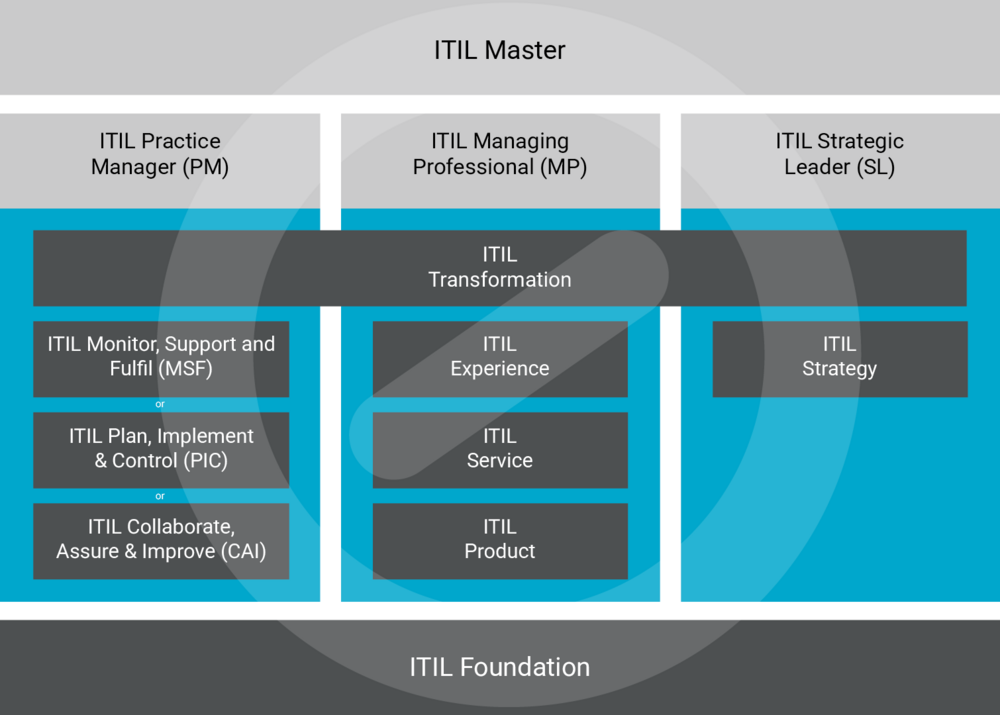
The certification program begins with the ITIL Version 5 Foundation and then leads to professional designations through three learning paths. These learning paths are the ITIL Practice Manager, the ITIL Managing Professional, and the ITIL Strategic Leader. Those who successfully complete all three designations achieve the highest certification level: ITIL Master. A central element of all learning paths is the ITIL Transformation module, which need only be completed once and counts toward all designations.
ITIL Version 5 training courses are offered in three different formats, so you can choose the learning model that best fits your daily routine and learning habits.
The in-person training takes place on-site and offers direct, face-to-face interaction with instructors and other participants. It is particularly well-suited for anyone who values a shared learning environment, discussions, and networking, and who would like to gain an in-depth understanding of ITIL Version 5 through direct dialogue.
In the " Virtual Classroom" training course, you participate in real time via a virtual learning platform. The training is conducted live by experienced instructors and is designed to be interactive. You can ask questions, discuss topics, and work together—almost as if you were all sitting together in a seminar room, but with maximum flexibility in terms of location.
The e-learning format allows you to learn entirely at your own pace. You can access the official course materials anytime, anywhere, and set your own pace. This format is particularly well-suited for participants who need maximum flexibility or who wish to work through the material over an extended period of time.
All three formats cover the same technical content and prepare you for the respective ITIL Version 5 certification. The choice of format depends solely on how you learn best and how the training can be integrated into your daily work routine.
The ITIL Version 5 Foundation is the official entry point into the certification program. It teaches the common language, key concepts, and fundamental models of ITIL Version 5. Participants learn how digital products and services are managed holistically, how value is created, and how collaboration, governance, and continuous improvement interact. The Foundation is a prerequisite for all advanced ITIL Version 5 certifications.
The ITIL Version 5 Foundation training course lasts two days. During these two days of training, all key concepts of ITIL Version 5 are taught in a concise, practical, and structured manner, enabling participants to develop a solid understanding of modern digital product and service management according to ITIL Version 5.
The ITIL Version 5 Transformation training is a central component of the entire certification program. It is a mandatory requirement for the ITIL Practice Manager, ITIL Managing Professional, and ITIL Strategic Leader designations. However, the training need only be completed once and is then credited toward all three learning paths. As such, it serves as the link between operational implementation, holistic management, and strategic leadership.
The ITIL Version 5 Transformation training course aims to enable participants not only to understand ITIL but also to implement it effectively and sustainably within their organizations. The course focuses on how improvements, changes, and transformations can be systematically planned, managed, and permanently embedded. The training teaches organizations how to make the transition from ad hoc initiatives to a structured, value-driven transformation approach.
If you already hold the ITIL 4 Practice Manager or ITIL 4 Strategic Leader designation and would like to transition to ITIL Version 5, you must successfully complete the ITIL Transformation module.
ITIL Transformation serves as the key bridge from ITIL 4 to ITIL Version 5.
Upon completion of this module, you will receive the corresponding ITIL Version 5 designation (Practice Manager or Strategic Leader).
Important to know:
- ITIL Transformation is mandatory, but it only needs to be completed once
- This module counts toward all ITIL Version 5 learning paths
- No additional ITIL 4 modules or exams are required
This ensures that the transition from ITIL 4 to ITIL Version 5 is clearly structured, efficient, and future-proof—with a consistent understanding of transformation, governance, and sustainable change.
The ITIL Version 5 Practice Manager training is a standalone learning path within the certification framework. After completing the ITIL Version 5 Foundation course, participants choose one of three practice specializations (Monitor, Support & Fulfill; Plan, Implement & Control (PIC); or Collaborate, Assure & Improve (CAI)), each of which consists of five clearly defined ITIL practices. Upon successful completion of this specialization, they earn the ITIL Version 5 Practice Manager designation. To earn the ITIL Version 5 Practice Manager designation, the ITIL Version 5 Transformation training and certification are also mandatory. Only the combination of practice specialization and transformation ensures that operational excellence and sustainable implementation are brought together. The Practice Manager learning path thus forms the operational pillar of ITIL Version 5 and—as with the ITIL Managing Professional—is closely linked to the Transformation module.
The ITIL Version 5 Practice Manager training course is designed to enable participants to effectively implement ITIL in their day-to-day operations. The focus is on the practical application of ITIL practices with clearly defined roles, responsibilities, and outcomes. The training teaches how to design operational processes to be stable, efficient, and traceable, and how to systematically integrate continuous improvement into daily work. The goal is not to understand ITIL in abstract terms, but to use it as a practical management tool for day-to-day operations.
The ITIL Service training is a core module in the ITIL Managing Professional learning path. It builds on the ITIL Foundation and deepens participants’ understanding of how services are managed throughout their entire lifecycle. The module complements the perspectives of ITIL Product, ITIL Experience, and ITIL Transformation, thereby contributing significantly to a comprehensive certification.
The ITIL Service Training course teaches participants how to holistically plan, manage, and continuously improve services in accordance with ITIL Version 5. The goal is not to view services in isolation, but rather as part of an integrated Digital Product & Service Lifecycle. Participants learn how services reliably deliver value, how stability and adaptability work together, and how services are consistently aligned with business and customer expectations.
The ITIL Product training and certification is one of the core modules in the ITIL Managing Professional learning path. It builds on the ITIL Foundation and complements the service perspective with a structured, lifecycle-oriented understanding of products. Together with ITIL Service, ITIL Experience, and ITIL Transformation, it forms the foundation for holistic management of digital value creation.
The ITIL Product training course teaches participants how to plan, develop, and manage digital products within the framework of ITIL Version 5. The goal is to systematically integrate product thinking with service management and to view products not in isolation, but as part of an integrated value creation system. Participants learn how products generate value throughout their entire lifecycle and how they interact with services.
ITIL Experience is a core module in the ITIL Managing Professional learning path. It complements the product and service perspectives by consistently focusing on the people who work with or use digital products and services. In this way, the module plays a crucial role in making value creation tangible—not just from a technical standpoint.
The ITIL Experience training program consistently focuses on the experience of customers and employees. The goal is to treat experience not as a “soft” factor, but as a controllable, measurable component of value creation. Participants learn how to systematically design, evaluate, and improve the experience—across products, services, and organizational boundaries.
ITIL Strategy is a core module in the ITIL Strategic Leader learning path. It builds on the ITIL Foundation and adds a strategic perspective to the certification scheme. Together with the ITIL Transformation module, it forms the basis for the ITIL Strategic Leader designation. The training ensures that ITIL Version 5 is not only understood at the operational level but can also be effectively applied at the strategic level.
The ITIL Version 5 Strategy training course teaches participants how to use ITIL as a strategic framework for modern organizations. The goal of the course is to integrate digital strategy, governance, investment decisions, and operational implementation. Participants learn how to clearly define and prioritize strategic goals and translate them into effective initiatives throughout the digital product and service lifecycle.
The focus is on the question of how organizations can create long-term value without sacrificing flexibility, innovation, or operational stability.
No. An existing ITIL 4 Foundation certification remains fully recognized and is a prerequisite for all advanced ITIL Version 5 modules. However, attending the ITIL Version 5 Foundation training may still be beneficial in order to better understand the new concepts, the expanded lifecycle, and the greater focus on product management, experience, and AI.
Participants who hold an ITIL v3 Foundation certificate and wish to transition to the ITIL Version 5 certification track must start over with the ITIL Version 5 Foundation.
The ITIL Version 5 Foundation and the Practice modules are administered as closed-book, multiple-choice exams. The Product, Service, Experience, Strategy, and Transformation modules are designed as open-book exams. The focus here is less on memorization and more on understanding, application, and informed decision-making.
ITIL Version 5 certifications are valid for three years. They can be renewed through ongoing professional development, additional ITIL certifications, or by retaking the exam. This ensures that knowledge remains up-to-date and aligned with new developments.
ITIL AI Governance is an extension module within ITIL Version 5. It addresses the responsible use of artificial intelligence, automation, and data-driven technologies. The module is intended for professionals and executives in all roles and effectively complements the certification framework without being a mandatory component.
ITIL 4 and ITIL Version 5 will be offered in parallel during an extended transition period. A specific end date for ITIL 4 has not yet been set. This parallel phase allows organizations and individuals to make an orderly transition without time pressure.
ITIL Version 5 provides a clear, future-proof framework for digital product and service management. Those who get started today will lay a solid foundation for addressing current challenges and future developments. The Foundation certification is the ideal starting point for understanding ITIL Version 5, putting it into context, and strategically planning further certifications.
ITIL Version 5 is a response to the realities of modern digital organizations. Today, products and services are no longer developed or operated in isolation, but are created in dynamic, interconnected, and often AI-supported environments. At the same time, customers, users, and employees have increasingly high expectations regarding quality, speed, and transparency.
ITIL Version 5 addresses these developments and provides a modern framework for organizations that want to manage digital products and services holistically. The focus is not on individual processes, but on creating value throughout the entire lifecycle. Especially now, ITIL Version 5 provides the clarity needed to make complexity manageable and enable informed decisions.
ITIL Version 5 does not conflict with agile methods or DevOps approaches; rather, it complements them effectively. While Agile and DevOps focus primarily on speed, collaboration, and continuous delivery, ITIL Version 5 provides the overarching framework for control, governance, and sustainable value creation.
ITIL Version 5 helps embed agile working practices within a clear organizational context, define responsibilities, and make decisions in a transparent manner. Especially in complex organizations, ITIL Version 5 thus bridges the gap between operational agility and strategic alignment.
ITIL Version 5 consistently focuses on results and value creation rather than on mere activity or process compliance. Digital products and services are considered throughout their entire lifecycle, with a clear definition of the benefits they are intended to deliver to customers, users, and organizations.
By providing a structured view of value streams, roles, responsibilities, and continuous improvement, ITIL Version 5 helps organizations create transparency and make progress measurable. Decisions are not made in isolation, but are always considered in the context of value, risk, and long-term impact.
Customer experience and employee experience are central components of ITIL Version 5. The framework recognizes that sustainable value creation can only occur when both customers and employees have positive experiences. ITIL Version 5 does not view experience as a side issue, but rather as an integral part of managing digital products and services. Organizations learn how to systematically design, evaluate, and improve experiences to ensure long-term acceptance, motivation, and quality.
Yes. ITIL Version 5 is explicitly designed for complex, automated, and AI-enabled environments. The so-called AI-native approach means that ITIL Version 5 provides guidance without prescribing technological details. The focus is on responsible management, transparency, governance, and decision-making capabilities in data-driven environments. In this way, ITIL Version 5 helps organizations integrate technological innovation into existing structures in a meaningful and sustainable way.
Yes. ITIL Version 5 is designed as an evolution and builds on existing ITIL investments. Concepts, mindsets, and certifications from ITIL 4 remain relevant and compatible. ITIL Version 5 expands on these foundations with new perspectives such as the integrated product and service lifecycle, a focus on experience, and AI-native governance. Existing knowledge is not being replaced, but rather meaningfully built upon and placed in a modern context.
ITIL Version 5 is not merely a certification update, but a comprehensive framework for modern digital management. The certifications are designed not only to impart knowledge, but also to foster ways of thinking, decision-making skills, and the ability to take action. With ITIL Version 5, participants gain a long-term perspective for their personal development and for shaping their organization. The certification serves as proof—but the real added value lies in its practical application and strategic context.
ITIL Version 5 is designed as a holistic certification and development path. The Foundation serves as the entry point, upon which various learning paths and specializations are built. Participants can tailor their path flexibly and deepen their skills step by step. This results not in isolated training, but in a sustainable learning process that grows alongside the requirements of the organization and the individual’s role. ITIL Version 5 supports continuous development—technically, organizationally, and strategically.
Yes. An existing ITIL 4 Foundation certification qualifies you to participate in all advanced training courses in the ITIL Version 5 certification scheme. Your ITIL 4 Foundation certification remains fully recognized and continues to serve as a formal prerequisite for the advanced modules and designations.
The ITIL Version 5 Transition training is a specially designed bridge certification that enables experienced ITIL professionals to make a structured and recognized transition to ITIL Version 5. It is specifically aimed at individuals who already hold advanced ITIL certifications and wish to update their existing knowledge without having to go through the entire certification track again. The Transition training is designed as a three-day intensive course. It consolidates all the key changes in ITIL Version 5 and places them in the context of existing ITIL knowledge. The focus is not on repeating familiar content, but on understanding the conceptual evolution and the new mindset of ITIL Version 5.
The ITIL Version 5 Transition is designed for individuals with advanced ITIL certifications from Versions 3 and 4 who wish to earn an official ITIL Version 5 designation. It is particularly relevant for holders of the ITIL v3 Expert certification as well as ITIL 4 Managing Professionals. For individuals with the ITIL 4 Master qualification, the Transition is also a prerequisite for advancing to the ITIL Version 5 Master qualification. The Transition is not required for ITIL 4 Practice Managers, as the content of this learning path has not changed in ITIL Version 5 and remains fully recognized.
Upon successful completion of the ITIL Version 5 Transition training and the associated certification exam, participants receive an official ITIL Version 5 designation, depending on their previous qualification. Those who are ITIL v3 Experts or ITIL 4 Managing Professionals will achieve the ITIL Version 5 Managing Professional designation after completing the Transition. Those who are ITIL 4 Masters will, upon completing the Transition, meet the formal requirement to obtain the ITIL Version 5 Master qualification. The Transition thus serves as a formal and substantive bridge between the previous ITIL generations and ITIL Version 5.
The ITIL Version 5 Transformation training course lasts three days. During these three days, the material is presented in a concise, practical, and structured manner, enabling participants to develop a solid understanding of transformation, change management, and the implementation of ITIL Version 5 in modern organizations.
The ITIL Version 5 Foundation course will be available in its entirety in German at SERVIEW starting March 1, 2026. Starting on that date, all ITIL Version 5 Foundation training courses will be conducted using SERVIEW’s own German training materials, based on the proven SERVIEW Workbook Principle®. The training itself will be conducted in German and will focus on practical application and clear presentation of the content.
The ITIL Version 5 Foundation exam can also be taken in German. The exam is administered online on a staggered schedule, allowing for flexible scheduling. This provides participants with a learning and exam environment conducted entirely in German.
Regardless, the ITIL Version 5 Foundation is already available in English. The English exam can be taken either online or as a paper-based exam. Of course, SERVIEW offers all ITIL Version 5 training courses entirely in English—both for international participants and for organizations with English-language training needs.
This allows participants to choose between German and English sessions—depending on their own language, organization, and objectives.
ITIL Version 5 training courses can be taken flexibly and from any location with SERVIEW. In-person training courses are held in 16 major cities across Germany, Austria, and Switzerland and offer a personalized learning environment with experienced ITIL instructors. In addition, ITIL Version 5 training courses are available throughout Europe as “ Virtual Classroom ” sessions. These formats allow participants to attend regardless of their location—with a live instructor, an interactive learning platform, and a strong practical focus, comparable to in-person training.
In addition, it is possible to complete the ITIL Version 5 course via e-learning worldwide. This format offers maximum flexibility in terms of time and location and is particularly well-suited for international participants or self-directed learning.
This means that ITIL Version 5 training courses are available in person, online, and globally—tailored to individual needs, organizations, and learning preferences.
In the ITIL environment to date, approximately 95% of participants have completed only the ITIL Foundation certification. With ITIL Version 5, this approach is intentionally changing. The new certification framework clearly distinguishes between understanding and implementation.
The ITIL Version 5 Foundation certification remains the mandatory starting point. It covers the fundamental concepts, terminology, models, and common framework of ITIL Version 5. Without this foundation, it is impossible to properly understand and contextualize additional content.
However, the ITIL Version 5 Transformation certification is a new and crucial development. It was specifically designed to bridge the gap between knowledge and application. This training is no longer about “What is ITIL?” but rather about “How do I effectively implement ITIL? ”—that is, planning, managing, changing, and sustainably embedding ITIL within the organization.
From today's perspective, therefore, the following applies:
Foundation and Transformation are the minimum requirements in the ITIL Version 5 certification scheme.
Only the combination of both training courses ensures that ITIL is not only understood but also effectively applied.
What is ... ? We'll explain!
Learn, in simple terms, what lies behind the frameworks, methods, and standards:
Are you familiar with our in-person training courses?
We also offer all ITIL Version 5 training courses in the following cities, via e-learning, or as Virtual Classroom .
See for yourself: SERVIEW Benefits

's On-Time Delivery Guarantee: 100% Reliable
Uncompromising reliability with the SERVIEW On-Time Guarantee. Plans derailed, last-minute cancellations, headaches? Not with us!

SERVIEW
Audit Insurance
A secure environment for taking your exam and a free retake if you do not pass.

Maximum flexibility:
SERVIEW Training Formats
Our training courses come in a wide variety of formats—there's something for every type of learner!