
What is ITIL?
ITIL has become the world’s leading framework for the governance, coordination, and management of services. The latest version,ITIL 4, in particular, can significantly improve the efficiency and quality of services and service organizations. As a result, customers benefit from consistent or even better results. Learn more about ITIL here.
A Few Words About ITIL
ITIL is an internationally recognized, vendor-neutral collection of best practices for service management. Its approach is process-based and ranges from the service provider’s strategy to the capture of customer requirements, through to operations and continuous improvement. Whether in IT, marketing, HR, after-sales, field, or facility management— ITIL is the global industry standard for any type of service organization.
ITIL, particularly in its latest version, ITIL 4, focuses on the entire value chain. All elements are intended to mesh seamlessly to generate value. To emphasize this, ITIL 4 introduces the concept of the Service Value System. But how are the individual processes and work steps interconnected? What activities are required to create value in ITIL 4? And how can their integration be designed efficiently and intelligently? ITIL addresses these and other questions—particularly in light of fast-paced, complex work environments (“VUCA World”).
What are the ITIL principles?
ITIL 4 follows seven key principles to ensure successful service management. These principles underpin and drive all activities within the value chain. They lay the foundation for the efficient implementation and maintenance of the framework. The seven ITIL principles are:
- Focus on value: Every activity must, directly or indirectly, create value or contribute to it. Anything that does not contribute to value creation is unnecessary baggage.
- Start where you are: Best practices that were already established in the organizationbefore the introduction of ITILshould be retained. Where necessary and possible, they will be further improved.
- Iterative development (Progress iteratively with feedback): Continuous improvement is a core element of ITIL 4. Improvements should be implemented frequently and in small steps to maintain the ability to act during periods of change.
- Promote Collaboration and Visibility: Clarity and transparency must be ensured in every form of collaboration. This applies to all communication, both within teams and with stakeholders and partners.
- Thinking and working holistically: Responsibility is assumed throughout the entire process. This applies to the entire ITIL 4 Service Value System.
- Focus on simplicity and practicality (Keep it simple and practical): Finding the right balance is crucial for every process, every tool, and all resources to enable streamlined and efficient value creation.
- Optimize and Automate: Manual work is prone to errors and consumes time and resources. No step that can be meaningfully automated should be performed by humans.
What is a service as defined by ITIL?
A service, as defined by ITIL, is a way to create value for customers. This involves encouraging and supporting these customers as they work toward achieving their goals. Customers do not bear certain costs and risks themselves in this process. In other words, by delivering services using ITIL 4, customers are supported in achieving their desired outcomes without having to shoulder certain burdens. In essence, it is a service provided to the customer.
How is ITIL structured? The Service Value System
ITIL 4 examines the Service Value System—that is, the totality of all interlinked value-creating elements—from four different dimensions:
- Value streams and processes—all activities that contribute to creating value for the customer
- Organizations and People—all employees who are directly involved in value creation, as well as the organizations in which they operate
- Information and Technology – Data Processing, Analysis, and Presentation
- Partners and suppliers—all individuals and organizations that contribute to the delivery of services
The focus here is not on the service itself, but on the value it provides to the customer. Therefore, within the Service Value System, ITIL 4 relies on a flexible value chain in which relevant key activities are defined. These steps do not have to be carried out in a rigid sequence but are tailored entirely to the needs and requirements of the respective organization, the customer, and the task at hand. As a result, ITIL can effectively support not only traditional approaches but also agile and hybrid ones.
The Value Chain in Detail
In ITIL 4, there are six core activities to which all steps in a value chain can be assigned. This makes it easier to understand even complex interrelationships. The six activities do not have to follow a predetermined sequence; rather, they flow seamlessly into one another in ITIL 4. They are:
- Plan
- Engage
- Design & Transition
- Obtain & Build
- Improve
- Delivery & Support
The “Engage” activity often—though not always—marks the beginning of a service value chain. It involves the interaction between service providers, stakeholders, and customers. This allows requirements to be captured more clearly and transparently. Maintaining relationships with the partners involved also falls under this term.
"Plan" refers to all service management plans, ranging from the strategic level to the operational planning of day-to-day service operations.
During the “Design & Transition” activity, new and modified services are designed. This activity provides virtually all the information required for the remaining activities in the ITIL value chain. Particular attention is paid to ensuring that expectations regarding the product’s quality, cost, and market readiness are met.
“Obtain & Build” refers to the development and deployment of components needed for new or modified services. This is done based on the collected requirements and in accordance with the previously defined specifications.
The “Improve” activity encompasses all components of service delivery, from organization and technologies to value streams and the ITIL practices themselves. ITIL explicitly aims for step-by-step, continuous improvement across all aspects. Therefore, this activity can be applied to all components of the service value chain.
Finally, “Deliver & Support” describes the actual operation of the services and products. This typically involves ongoing support, with particular emphasis in ITIL 4 on ensuring that services are deployed with minimal disruptions and in accordance with requirements.
ITIL Processes or ITIL Practices?
In the previous version, ITIL v3 , many activities were defined through what are known as ITIL processes. These 26 clearly defined workflows were characterized above all by structure: a defined input produced a desired output. The path was determined by measurable metrics such as performance, costs, and quality characteristics. The process began at a predefined starting point and ended with a specifically designated customer or stakeholder. Ongoing management and control ensured greater transparency and had to be factored into the process design from the outset.
In ITIL 4, this process model has given way to the more flexible ITIL Practices. Instead of 26 defined processes, ITIL 4 provides a total of 34 practices that, rather than rigid procedures, describe the organization’s capabilities for managing services, technologies, and broader subject areas. For example, ITIL 4 introduces, for the first time, a practice dedicated to risk management. Workforce and talent management—which had not previously been addressed in this form—also takes its rightful place in service management.
What is ITIL certification?
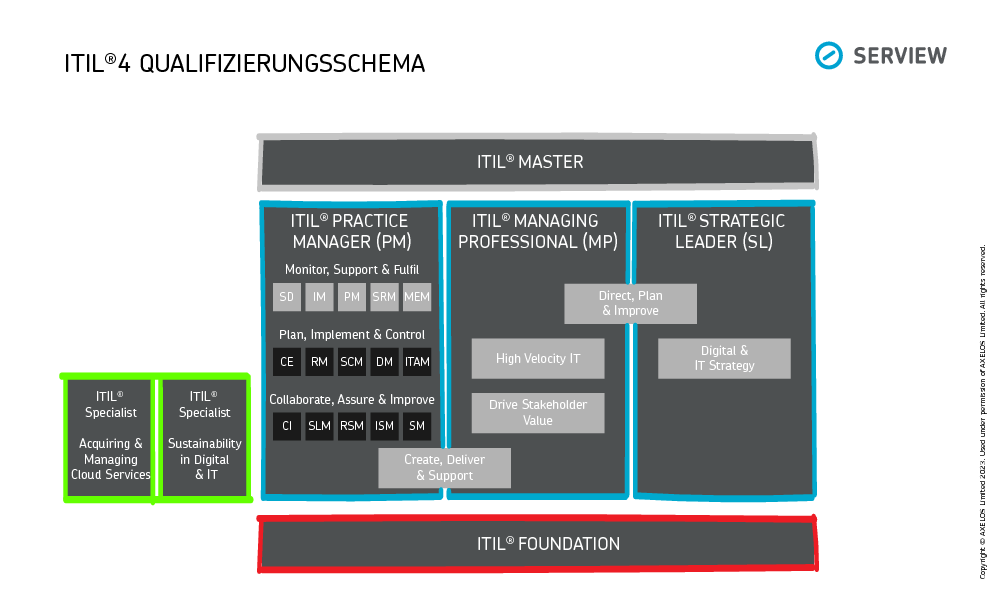
To effectively implement ITIL-based service management in your organization, you can enroll yourself and your employees in practical ITIL training courses. The ITIL Foundation course serves as the foundation for all other ITIL certifications. In the next step, you can advance to the level of Managing Professional or Strategic Leader. You can find a comprehensive overview of all ITIL certifications in our official ITIL certification framework.
Or would you like to get started right away with targeted professional development? Then book your ITIL training right here!
Are there any new ITIL training courses?
Since early 2022, in addition to the regular ITIL 4 certification track, we have been offering two training courses: “ITIL 4 Sustainability in Digital & IT”and“Acquiring & Managing Cloud Services.”These so-called extension modules are not part of the certification path for the ITIL 4 Managing Professional or Strategic Leader, but rather address current issues and challenges in service management. Here, the topics of sustainability, scalability, and the strategic alignment of your ITIL 4 services are discussed in depth. What makes these courses special is that no prior knowledge is required for these two ITIL 4 certifications. This allows you to focus on these important topics for the future even without having completed the ITIL 4 Foundation course.
What is ... ? We'll explain!
Learn, in simple terms, what lies behind the frameworks, methods, and standards:
Are you familiar with our in-person training courses?
We also offer all ITIL training courses in the following cities, as e-learning,
blended learning, or as Virtual Classroom .
See for yourself: SERVIEW Benefits

's On-Time Delivery Guarantee: 100% Reliable
Uncompromising reliability with the SERVIEW On-Time Guarantee. Plans derailed, last-minute cancellations, headaches? Not with us!

SERVIEW
Audit Insurance
A secure environment for taking your exam and a free retake if you do not pass.

Maximum flexibility:
SERVIEW Training Formats
Our training courses come in a wide variety of formats—there's something for every type of learner!